For years, many private limited liability companies in Indonesia, both foreign-owned (PT PMA) and local (PT PMDN), treated the Annual General Meeting of Shareholders (GMS) as an internal formality. If there were no changes to the board of directors, commissioners, or shareholding structure, the meeting minutes were simply filed away in corporate records.
Those days are over. Under Minister of Law and Human Rights Regulation No. 49 of 2025 (Permenkumham 49/2025), Indonesia has fundamentally overhauled its corporate compliance enforcement.
Annual GMS reporting is now strictly mandatory. Failure to report your annual corporate resolutions through the government portal will trigger an automatic freeze on your corporate legal status, bringing your day-to-day business operations to a grinding halt.
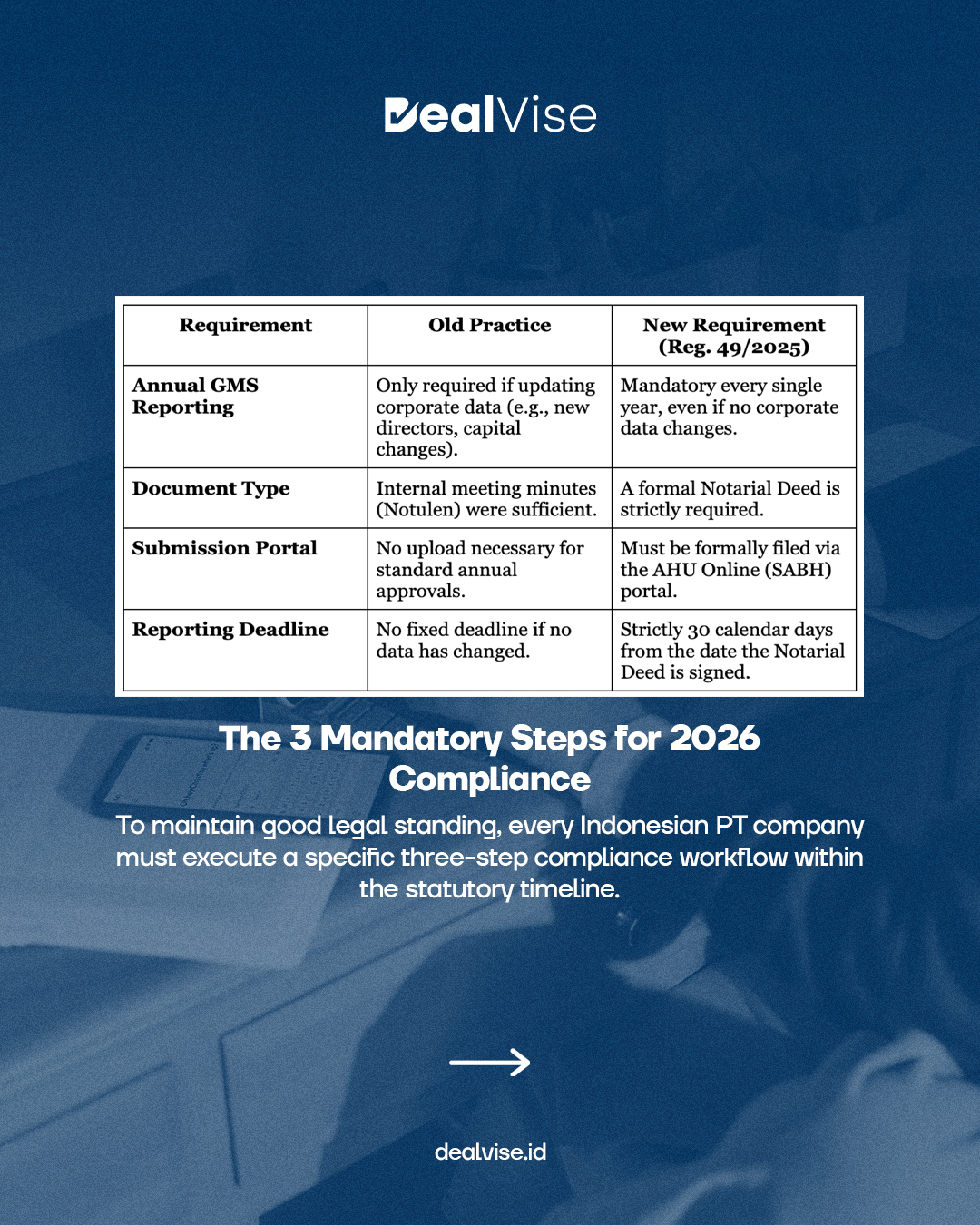
What Has Changed? Old vs. New Rules
The shift represents a move from a voluntary, “reporting by exception” model to a strict, proactive annual filing system.
The Consequences of Non-Compliance: AHU System Blocking
The Indonesian government enforces this regulation via automated system sanctions. If your company misses its annual reporting window, the Ministry of Law will automatically block your company’s AHU profile.
Operational Freeze Warning: AHU block effectively locks your corporate legal status. While blocked, your company is legally and systematically prohibited from:
Appointing, replacing, or extending the terms of Directors or Commissioners.
Injecting new capital or changing the shareholding structure.
Amending the company’s Articles of Association (such as changing the business address or corporate purpose).
Updating bank Know-Your-Customer (KYC) records, which can freeze corporate accounts.
Renewing or modifying essential business licenses via OSS (Online Single Submission) or OJK.
Document Checklist for 2026 Filings
The compliance process requires two distinct layers of documentation: what you must give to your notary, and what must ultimately be uploaded to the government system.
1. Documents Required by the Notary (To Draft the Deed)
Before a notary can formalise your corporate resolution, you must provide:
Internal GMS Minutes (Notulen): Signed minutes explicitly showing shareholder approval of the 2025 financial year.
Attendance List (Daftar Hadir): Signed proof that the meeting met the legal shareholder quorum.
Annual Report & Financial Statements: Balance sheets and profit/loss statements (audited, if your company meets mandatory audit thresholds).
Corporate Legality Docs: The original Deed of Establishment (Akta Pendirian), all subsequent amendments, and the latest Ministry approval decrees (SK Kemenkumham).
KYC & Tax Identification: NIB (Business Identification Number), plus clear copies of passports/KTPs and tax cards (NPWP) for all directors, commissioners, and shareholders
2. Documents Uploaded to AHU Online
Once the notary reviews the files, the final submission to the SABH portal includes:
The finalised Notarial Deed approving the Annual Report.
A PDF copy of the Annual Report File.
A mandatory Beneficial Owner (BO) Declaration statement.
A Power of Attorney (PoA) from the Board of Directors authorising the filing.
Proof of payment for the PNBP (Non-Tax State Revenue) government filing fee.
Protecting Your Business in 2026
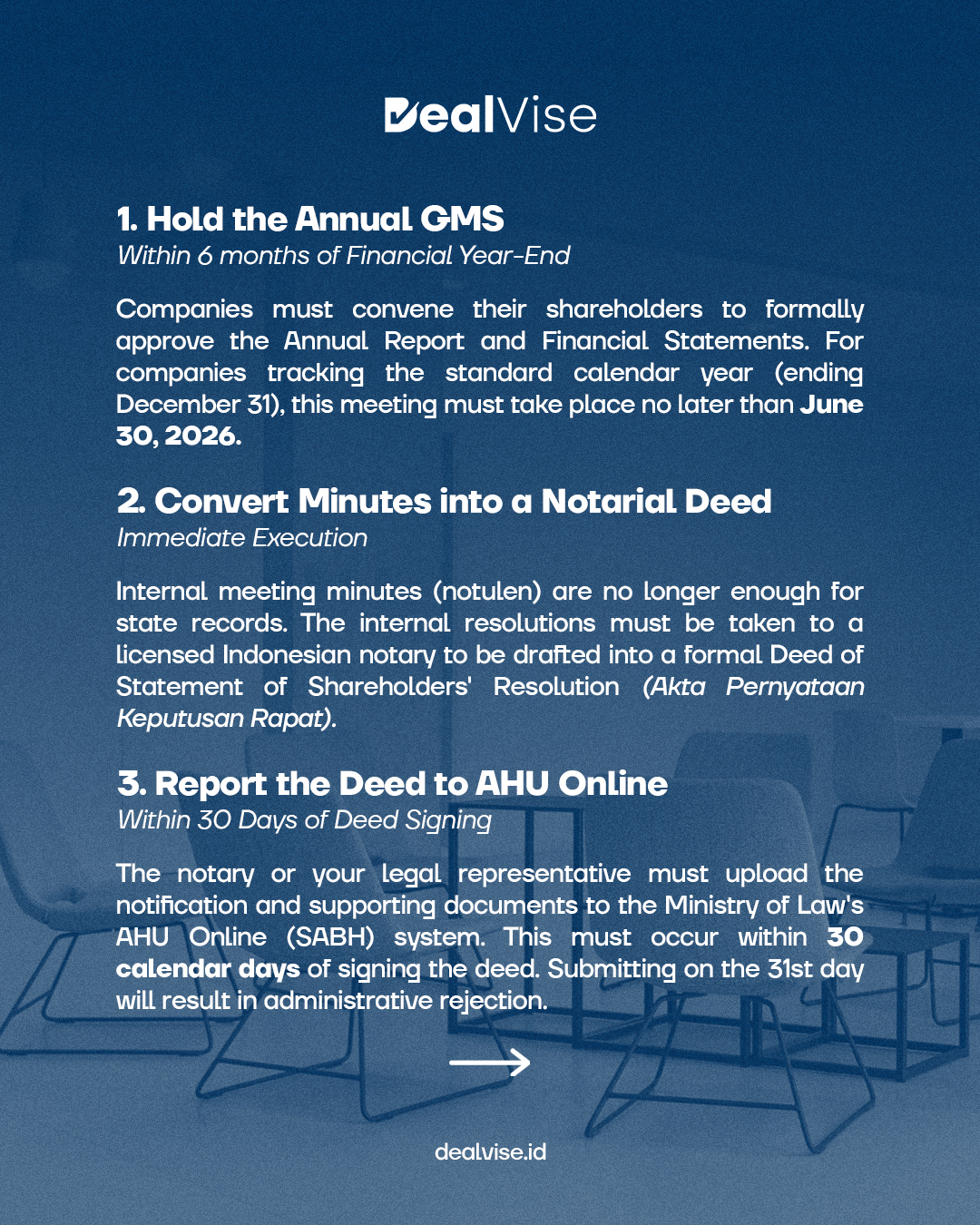
Annual GMS compliance is no longer a minor back-office task to put off—it is a critical, time-sensitive operational requirement. Delaying your filing can freeze your corporate mobility, disrupt vendor payments, and halt expansion plans.
If you manage a PT PMA or PT PMDN in Indonesia, ensure your corporate secretarial team or legal consultant coordinates with a licensed notary well ahead of the June 30th deadline to avoid administrative penalties and automatic system blocking.